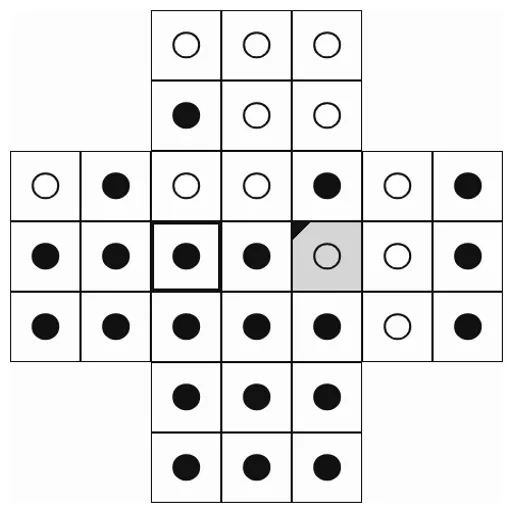
Peg Solitaire is a one-player board puzzle that has been around for centuries. All the holes but one start filled, and each move jumps a peg over a neighbor and removes the one it jumped. Your goal is to end with only one peg standing. This Peg Solitaire comes from Christopher Müller’s open-source PaperGames collection, with six boards drawn in clean black and white.
Making a jump
Select a peg, then choose an empty hole two spaces away in a straight line with a peg directly in between. Your peg lands in the hole and the middle peg is removed. When you pick a peg, every hole it can legally reach is marked, so you never have to guess what is allowed.
On the square-grid boards, jumps run up, down, left or right. The triangle also allows its two slanted directions. A counter above the board shows how many pegs are left.
The game ends when no jump remains. One peg left means you solved it. Any more and the game tells you the count, and you can undo or restart.
Peg Solitaire Controls
| Action | Keyboard | Mouse | Touch |
|---|---|---|---|
| Select a peg | Tab to the peg (arrow keys move across the board), then Enter | Click the peg | Tap the peg |
| Jump into a hole | Move to the marked empty hole, then Enter | Click a marked empty hole two spaces away | Tap a marked empty hole two spaces away |
| Take back a jump | — | Click "Undo" | Tap "Undo" |
| Change board or restart | — | Choose a board, then click "New game" | Choose a board, then tap "New game" |
The thinking skill: planning with no way back
Each jump removes a piece forever, so this is a puzzle about consequences. A move that looks harmless can strand a peg on the far side of the board, and you will not notice until twenty moves later. Good players learn to look for pegs that are about to become isolated and fix them early.
Mathematicians have studied peg solitaire for a long time, using color patterns on the board to prove which end positions are possible. You do not need that theory, but it shows how a simple game can hide deep structure.
Solving tips
- Begin small. The 15-hole triangle and the 6 by 6 square teach the moves before the 33-hole cross.
- Clear one arm at a time. On cross boards, finish an arm before moving on, instead of leaving lone pegs all over.
- Protect the edges. A peg with no neighbors can never move or be jumped. Check the rim before each jump.
- Look for removal patterns. Many solutions clear a row of three pegs using a repeating set of jumps that keeps the rest of the group together.
- Back up when you see trouble. Undo has no limit, so step back several jumps and try another order.
Practical Notes for Players
Your game in progress returns after a reload, and arrow keys move across the board if you prefer the keyboard. A small board takes five minutes, while the English cross can take many tries. For another puzzle where every move counts, try Black Hole Square, or stack disks in Tower of Hanoi.
Tested and updated: