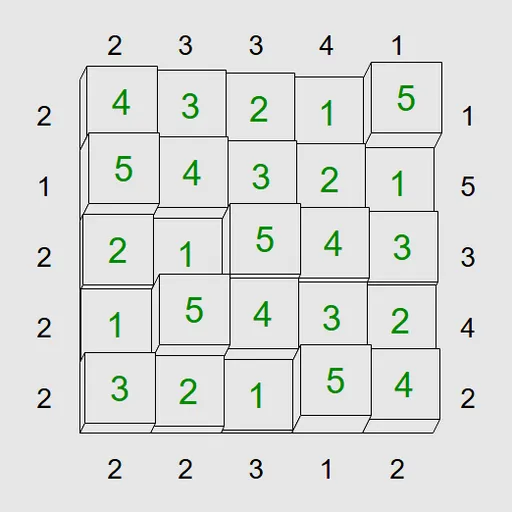
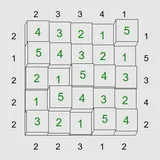
Skyscraper Sightlines is a logic puzzle about a tiny city seen from the edges. You place one tower in every square, using each height once per row and column, and the numbers around the border tell you how many roofs are visible from that point. It is Towers from Simon Tatham’s Portable Puzzle Collection, shown in a tidy 3D view. It is worth playing because each clue packs a surprising amount of information about order and size.
What You Need to Do
On a 5x5 grid, towers come in heights 1 to 5. Each row and column uses all five heights exactly once. Then the edge clues add a second condition.
A clue counts the towers you would see looking along that line from outside. Taller towers block shorter ones behind them. Take the row 3, 1, 4, 2, 5. From the left you see 3, 4 and 5, so the clue is 3. From the right, the 5 hides everything, so the clue is 1.
Click a square and type a height to build. Right-click to add pencil marks for heights you are still considering. Repeated heights and broken clues show in red, and the grid flashes when you finish.
Skyscraper Sightlines Controls
| Action | Keyboard | Mouse | Touch |
|---|---|---|---|
| Build a tower | Arrow keys to pick a square, then type its height | Click a square, then type a digit | Tap a square, then tap a digit button |
| Add or remove a pencil mark | Enter switches the cursor to pencil mode, then type a digit | Right-click a square, then type a digit | Set Tap to Pencil mark (or press and hold a square), then tap a digit |
| Clear a square | Space, Backspace or 0 | — | Tap the square, then Clear |
| Fill every empty square with all pencil marks | M | — | — |
| Grey out a clue you have finished with | — | Click the clue | Tap the clue |
| New game, undo, redo | N, U, R | Menu buttons above the grid | Menu buttons above the grid |
The Reasoning Behind the Clues
A visibility count is really a statement about increasing runs. A clue of c means c towers form a rising sequence of “new tallest” values from that side. That gives firm limits. The square next to a clue of c can be at most N minus c plus 1 tall, since you need room for c minus 1 taller towers after it.
Clues on opposite ends of a line work together. A 2 on the left and a 2 on the right of a 5-wide row mean the 5 cannot sit at either end, which narrows its spot fast.
A Solving Order That Helps
- Place the tallest towers beside every 1.
- Fill full lines beside clues equal to N. They must climb 1, 2, 3 and so on from that side.
- Cap the squares next to big clues using the N minus c plus 1 rule.
- Press M for full pencil marks, then trim them as each row fills.
- Grey out spent clues by clicking them, so the remaining ones stand out.
Quick Facts About This Version
The Type menu offers presets from 4x4 to 6x6 across four difficulty levels, and Custom goes up to 9x9. A Solve button shows the answer, and you can undo it to keep trying. Phones get a digit bar under the grid. For more Latin-square logic, try Greater-Than Grid, or switch to dice and probability with Five Dice Scorecard.
Tested and updated: