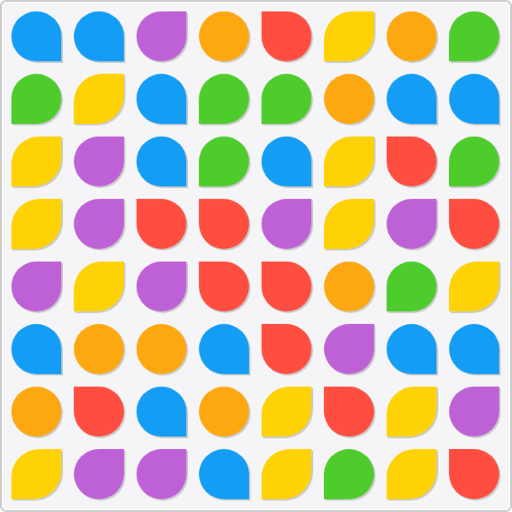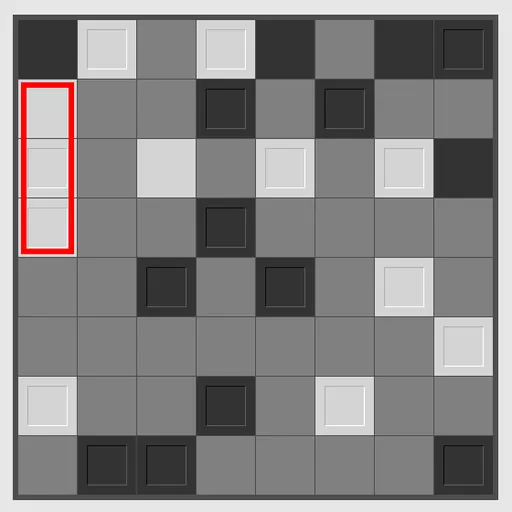
Unruly Black and White is a two-color grid puzzle with very little to learn and a lot to think about. A few squares start black or white, and you fill in the rest so every row and column is balanced and no three neighbors in a line match. Lennard Sprong wrote Unruly Black and White, known as Unruly, for Simon Tatham’s Portable Puzzle Collection, based on a puzzle type Adolfo Zanellati invented under the name Tohu wa Vohu.
Two rules, nothing else
- Balance. Every row and every column ends up exactly half black and half white. That is why grid sizes are always even.
- No triples. Three squares of the same color may never sit next to each other in a row or column.
Empty squares are medium gray. Left-click one for black or right-click for white, and click again to cycle on through the other color and back to empty. When you break a rule, the problem is outlined in red. The board is done when every square is filled and both rules hold everywhere. Presets run from an 8x8 Trivial grid to 14x14 Normal.
Unruly Black and White Controls
| Action | Keyboard | Mouse | Touch |
|---|---|---|---|
| Make a square black (then white, then empty) | Arrow keys to the square, then Enter | Left-click the square | Tap the square |
| Make a square white (then black, then empty) | Space | Right-click the square | Press and hold the square |
| Clear a square | Backspace | Middle-click, or keep clicking until it is empty | Keep tapping until it is empty |
| Undo, redo, new puzzle | U / R / N | Undo move, Redo move and New game buttons | Undo move, Redo move and New game buttons |
The binary logic inside
Every square is a yes-or-no choice, the same on-off idea computers use. The puzzle teaches you to reason with that kind of information quickly. The no-triples rule gives you local moves, and the balance rule gives you counting moves, so you keep switching between looking closely and counting across a line.
It is also a gentle lesson in parity. On an 8-wide row, four of each color must appear, so once four blacks are in, the rest are white without any thinking at all.
Moves to learn first
- Cap every pair. Two matching squares side by side force the opposite color on both ends.
- Fill the sandwich. Two squares of one color with a single gap between them force the gap to be the other color.
- Count the line. Once a line has half its squares in one color, the rest take the other.
- Check near-full lines. If a row needs just one more black, test which empty spots would leave three whites together.
- Bounce between rows and columns. Every new square is a clue for its other line too.
Small Details That Help
Undo and redo are unlimited, and the full game works by keyboard, mouse or touch. A small grid takes a few minutes. For a different two-state puzzle, try Slant Diagonals. For grids built on numbers, browse the math games section.
Tested and updated: