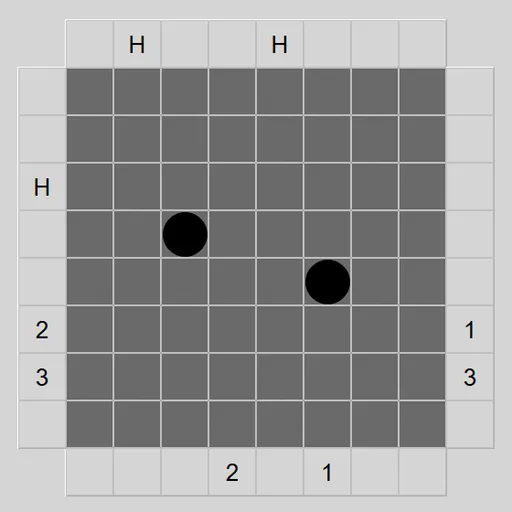
Black Box Lasers is a deduction puzzle where you never see the thing you are looking for. A few balls are hidden in a dark grid, and your only tool is a laser you can fire in from the border. Each beam comes back with a small report, and Black Box Lasers rewards you for squeezing the most information out of the fewest shots.
A round, step by step
You start with an empty-looking box ringed by edge squares. Pick one and a beam travels straight inward. What happens next depends on the balls nearby:
- A ball directly in the beam’s path swallows it, and the edge square shows H.
- A ball diagonally ahead makes the beam turn 90 degrees away from it.
- A beam that ends up leaving through its own entry square shows R.
- Any other beam exits somewhere else, and both ends get the same number.
When you think you know the layout, click inside the box to drop guesses. Once you have marked as many balls as the box holds, a check button appears in the top left corner.
Black Box Lasers Controls
| Action | Keyboard | Mouse | Touch |
|---|---|---|---|
| Fire a laser | Arrow keys to an edge square, then Enter | Left-click a square on the edge | Tap a square on the edge |
| Place or remove a guessed ball | Arrow keys inside the box, then Enter | Left-click inside the box | Tap inside the box |
| Lock a square, row or column | Space | Right-click a square, or an edge square for its whole row or column | Press and hold |
| Check your guesses | Move to the button in the top left corner, then Enter | Click the button that appears in the top left corner | Tap the button that appears in the top left corner |
| Undo, redo, new box | U / R / N | Undo move, Redo move and New game buttons | Undo move, Redo move and New game buttons |
The reasoning behind each shot
This is a game about cause and effect running backward. You see the result and must work out the cause, which is how scientists read indirect evidence. A single beam rarely proves anything alone. The skill is combining several readings until only one arrangement fits them all.
It also trains geometry in a quiet way. Every deflection is a right-angle turn, so you end up tracing paths in your head and checking which squares a beam could have crossed.
How to spend your shots wisely
- Probe the center lines early. A beam through the middle row or column touches the most squares, so its result narrows things down fastest.
- Treat an H as a lead, not an answer. The ball sits somewhere on that beam’s route, which may include a bend before the hit.
- List every way an R can happen. It can mean a ball sits just inside the entry, diagonally, or that the beam made two turns and came home.
- Be careful with straight exits. A beam leaving directly opposite usually means a clear lane, but a pair of bends can fake it. Confirm with a crossing shot.
- Lock the squares you have cleared. Locked squares, rows and columns cannot take a ball by accident.
Things Worth Knowing First
Undo and redo are unlimited, so a misplaced guess costs nothing. Sessions are short: a default box takes most players five to fifteen minutes. If you enjoy hidden-object logic, try Logic Mines next, the shot-by-shot search in Crater Space, or the mirror-bounce counting in Undead Mirror Maze.
Tested and updated: