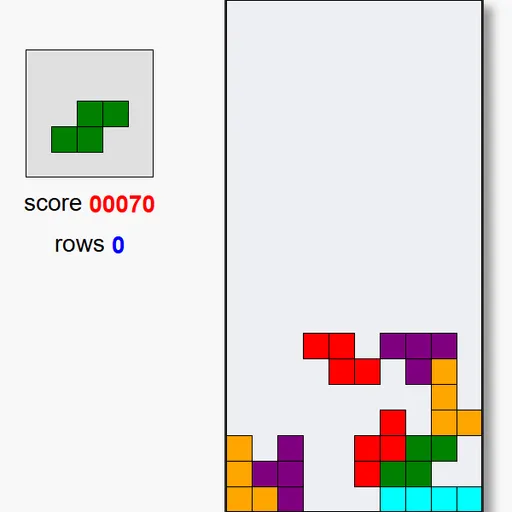
Block Drop is a stripped-down falling-shapes puzzle: seven kinds of four-square pieces tumble into a court 10 cells wide and 20 tall, and you rotate and steer them into gaps. It is worth your time because it trains mental rotation, the skill of picturing how a shape looks after a quarter turn, under a gentle but steady clock.
A round, step by step
Press Space to begin. A piece enters at the top and sinks one row at a time. You can shift it sideways, turn it, or nudge it down while it falls. Once it cannot move lower it locks, and the shape waiting in the preview box takes its turn.
Fill all ten cells of a row and that row vanishes, letting everything above settle. Your line count and score sit on the left. When a fresh piece has no space to appear, the run is over and the start prompt returns.
Block Drop Controls
| Action | Keyboard | Mouse |
|---|---|---|
| Start a new game | Space | Click "Press Space to Play." |
| Move the piece left or right | Left and Right arrows | — |
| Rotate the piece | Up arrow | — |
| Drop the piece one row faster | Down arrow (hold to keep dropping) | — |
| End the current game | Esc | — |
The spatial thinking behind it
Each piece can face four directions, and you rarely have time to try them all on screen. Good players learn to “see” the rotated outline in their head and match it to the dips in the stack. Psychologists use similar shape-turning tasks to measure spatial ability, which also matters in geometry and technical drawing.
There is planning too. Since the next shape is always visible, you are really placing two pieces at once and asking which order keeps the surface usable.
The speed curve is simple math. A piece starts by falling one row every 0.6 seconds, and each cleared line trims that delay until it reaches 0.1 seconds after 100 lines. Your skill is what sets how fast the game becomes.
Habits that keep a stack alive
- Build low and fairly level. Gentle one-step ledges accept almost any piece, while a narrow pit only fits the straight bar.
- Keep one wall column empty for the four-long piece, then cash in four rows together.
- Turn the piece while it is still high up. Rotation fails when a wall or block blocks the new position.
- Remember spawns are random. A tower on the far left is as dangerous as one in the middle.
- Tap Down rather than holding it when you are close to the target spot.
Small Details That Help
Pieces come from a shuffled bag holding four of each shape, so long droughts of one shape are less likely than pure chance would give. There is no sound and no save, so a session can be five minutes or an hour. If you enjoy fitting shapes, try the hexagon version at Hextris or clear colored groups in Same Game Blocks.
Tested and updated: