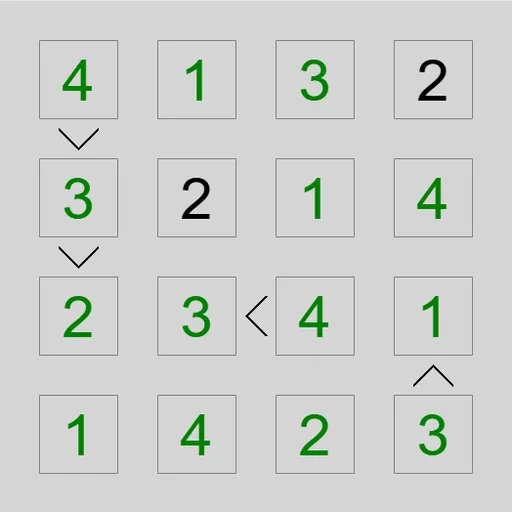
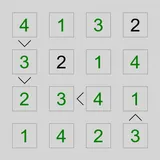
Greater-Than Grid is a number puzzle where the clues are the inequality signs sitting between squares. You fill the board so each row and column holds every digit once, and every sign points the right way. It is Unequal, by James Harvey, from Simon Tatham’s Portable Puzzle Collection. It is a quiet but sharp way to practice comparing numbers and chaining inequalities.
How the Puzzle Is Set Up
A grid of size N uses the digits 1 to N, with each digit once per row and once per column. On a 5x5 board that means 1 through 5 in every line.
In Unequal mode, a sign between two neighbors tells you which one is larger. Some squares may start with digits filled in, and tougher boards show fewer signs. In Adjacent mode the signs are replaced by bars, and a bar means the two digits are one apart, like 4 and 5.
Click a square and type a digit, or right-click for pencil marks. The grid flashes when everything is valid. Presets go from 4x4 Easy to 7x7 Extreme, and Custom allows larger grids.
Greater-Than Grid Controls
| Action | Keyboard | Mouse | Touch |
|---|---|---|---|
| Enter a digit | Arrow keys to move, then type the digit | Click a square, then type a digit | Tap a square, then tap a digit button |
| Add or remove a pencil mark | Enter switches the cursor to pencil mode, then type a digit | Right-click a square, then type a digit | Set Tap to Pencil mark (or press and hold a square), then tap a digit |
| Clear a square | Space, Backspace or 0 | — | Tap the square, then Clear |
| Fill in every possible pencil mark / also remove the obvious ones | M / H | — | — |
| Grey out a clue sign you have used | Shift or Ctrl + arrow key next to the clue | Click the sign | Tap the sign |
| New game, undo, redo | N, U, R | Menu buttons above the grid | Menu buttons above the grid |
The Logic of Inequalities
Each sign is a tiny inequality, like a < b. Chains of them work like the transitive rule from algebra: if a < b and b < c, then a < c. A chain of three rising squares on a 5x5 grid means the bottom one is at most 3 and the top one is at least 3. Seeing those limits is the key skill.
Bounds from both ends meet in the middle. The smallest digit in a long chain gets squeezed up from below, while the largest gets squeezed down from above. Often there is only one way to fit everything.
Ways In
- Mark the extremes. A square on the small side of any sign can never be N, and a square on the large side can never be 1.
- Find local minimums. A square smaller than every neighbor around it is often a 1 or 2.
- Count chain lengths. A chain of k rising squares forces the first one to be at most N minus k plus 1.
- In Adjacent mode, read the gaps. A 3 with no bars beside it rules out 2 and 4 in every neighbor.
- Grey out used signs. Clicking a sign once both sides are filled keeps your eyes on the live clues.
Small Details That Help
You can solve, undo and redo as much as you like, and a Solve button reveals the answer if you get stuck. Small grids take a few minutes, while 7x7 Extreme can be a long session. The same rule set appears in newspapers as Futoshiki. Next, try the sightline counting of Skyscraper Sightlines or the cage sums of Math Cage Grid.
Tested and updated: