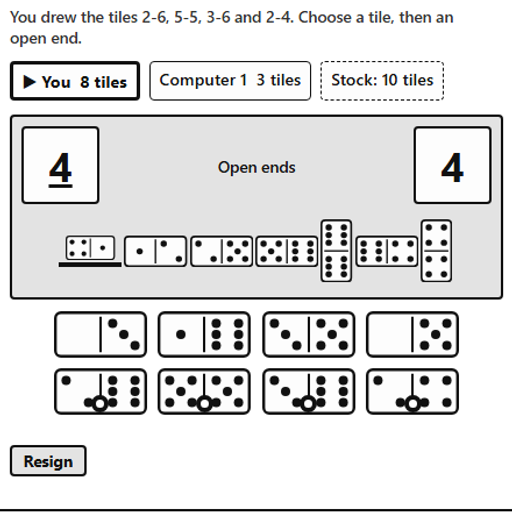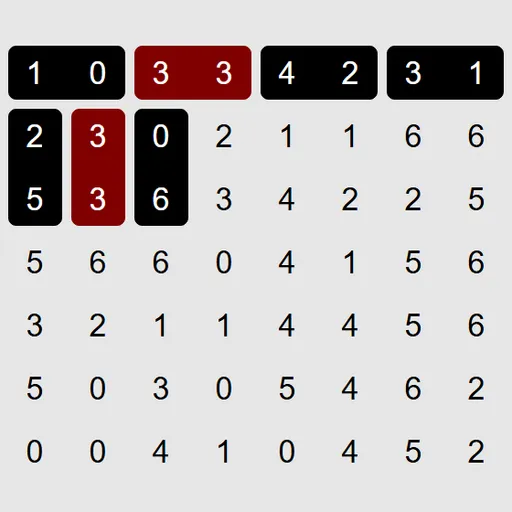
Dominosa Domino Logic hands you the trace of a domino layout. A complete set was placed in a rectangle, the number on each half was written down, and then the dominoes were taken away. You see only the numbers, and you must put every domino back so each pair appears exactly once. It is Dominosa from Simon Tatham’s Portable Puzzle Collection, and it is a sharp exercise in counting and elimination.
Setting Up the Board
The standard set runs from 0 to 6. One domino exists for every pair, doubles included, so there are 28 dominoes covering an 8 by 7 grid. Each domino covers two squares that sit side by side or one above the other.
Click the gap between two neighboring numbers to place a domino across them. Click again to remove it. Right-click a gap to draw a short line, your note that no domino goes there. The puzzle is solved when every square is covered and no pair repeats.
Dominosa Domino Logic Controls
| Action | Keyboard | Mouse | Touch |
|---|---|---|---|
| Place or remove a domino | Arrow keys to a spot between two numbers, then Enter | Left-click between two neighboring numbers | Tap between two neighboring numbers |
| Draw or erase a "no domino here" line | Space | Right-click between two numbers | Press and hold between two numbers |
| Highlight every copy of a number | Type the number | Right-click on the number | Press and hold on the number |
| Undo, redo, new puzzle | U / R / N | Undo move, Redo move and New game buttons | Undo move, Redo move and New game buttons |
Where the Math Comes In
A full set with numbers 0 to N has (N + 1)(N + 2) / 2 dominoes. For 0 to 6 that is 7 x 8 / 2 = 28. This is the same formula as counting handshakes in a room, plus the doubles, and it shows why the grid is always N + 2 wide and N + 1 tall.
The solving itself is about scarcity. Each pair has exactly one home. If the pair 1-4 can only fit in one place on the whole board, it must go there, and every other spot that could have held 1-4 is now off limits.
Deduction Techniques
- List every spot for one pair. Choose a pair, like 3-5, and find all adjacent places it could sit. A single option means the domino is fixed.
- Look for trapped squares. A square with only one free neighbor must pair with it.
- Cross off duplicates. After placing a pair, draw lines through every other spot where that same pair appears.
- Check doubles early. Two equal numbers side by side are often the only place that double can go.
- Highlight numbers. Typing a number, or right-clicking one, lights up every copy so pairs are easier to scan.
Things Worth Knowing First
Difficulty runs from Trivial to Extreme, and Undo and Redo have no limit. Smaller sets take a few minutes, while a set up to 9 is a long, rewarding session. Keyboard, mouse and touch all work. If you like pairing logic, try Magnet Dominoes next, or the island links of Bridges Island Puzzle.
Tested and updated: