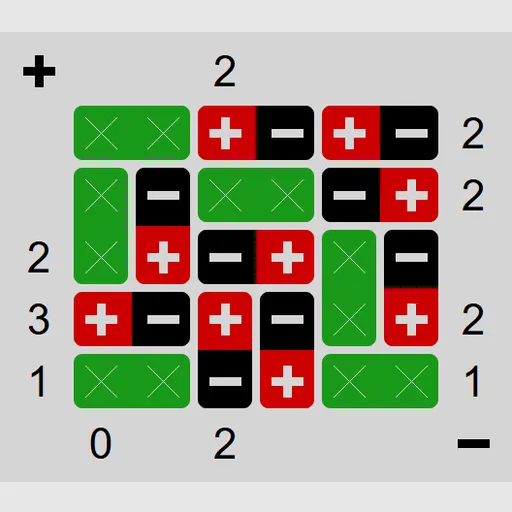
Magnet Dominoes gives you a grid already cut into domino shapes, all grey. Some dominoes are magnets with a plus end and a minus end, and the rest are blank. The numbers around the edge tell you how many plus and minus poles each row and column holds. Your job is to work out every domino. It is Magnets, by James Harvey, from Simon Tatham’s Portable Puzzle Collection, and it is solved without guessing.
The Rules
Each domino covers two squares. A magnet places a plus on one square and a minus on the other. A blank has two neutral ends.
The top and left clues count plus poles in each column and row. The bottom and right clues count minus poles. Two equal poles may never touch along an edge, while neutral ends may touch anything.
Click a domino to place a magnet with plus on the square you clicked. Click again to flip it, and again to clear it. Right-click to mark a domino blank. The board flashes when every domino is right.
Magnet Dominoes Controls
| Action | Keyboard | Mouse | Touch |
|---|---|---|---|
| Place a magnet, flip it, then remove it | Arrow keys to move, then Enter (repeat to cycle) | Left-click a domino (repeat to cycle) | Tap a domino with Tap set to Magnet |
| Mark a blank domino, then "cannot be blank", then clear | Space (repeat to cycle) | Right-click a domino (repeat to cycle) | Press and hold, or set Tap to Blank domino and tap |
| Grey out a finished clue | — | Click the clue | Tap the clue |
| New game, undo, redo | N, U, R | Menu buttons above the grid | Menu buttons above the grid |
Counting Logic in Action
Each row gives you two numbers, and they constrain each other. A magnet lying along a row adds one plus and one minus to it. An upright magnet only adds one pole to each of the two rows it crosses. So if a row’s plus and minus counts differ, the difference must come from upright magnets. That is a nice bit of bookkeeping, similar to balancing an equation.
The no-touching rule spreads information. Fix one magnet, and its neighbors lose options right away.
Practical Steps
- Add each row’s two clues. If they equal the row length, the row has no blanks at all.
- Treat zeros as strong clues. A plus count of 0 means every square in that line is minus or neutral.
- Spread from each magnet. The squares beside a plus cannot be plus.
- Note likely magnets with question marks before you know which way they face.
- Grey out met clues by clicking them.
Saving, Devices and Play Time
Eight presets cover three board sizes at Easy or Tricky. Undo is unlimited, and a Solve button is there for checking. On touch screens, a tap places magnets and press and hold marks blanks, with a switch to swap them. Next, try the full-set logic of Dominosa Domino Logic or the shading rules of Range Shading Puzzle.
Tested and updated: