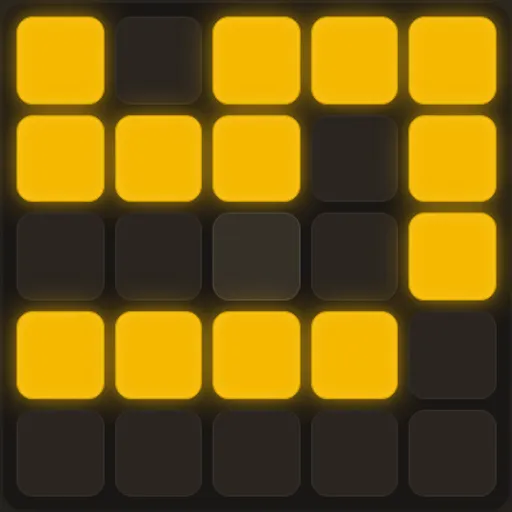
Light Switch Grid is a 5x5 board of amber lights where every cell is a switch. Pressing a cell flips it and the four cells beside it, above, below, left and right. Your task is to turn the whole board dark. It comes from Tejas Wavde’s open-source game collection, with a retro terminal look. It is worth playing because a few simple rules hide a surprising amount of structure.
How It Plays
The board opens with some lights on. Press a cell and it, plus its side neighbors, switch to the opposite state. Diagonals do not change, and edge cells just have fewer neighbors. A status line counts the lights still on, and a move counter tracks each press.
When the last light goes out, you see your move total. If it is your lowest at that level, it becomes your Best. Undo steps back one press, reset restores the starting board, and new rolls a random one.
Light Switch Grid Controls
| Action | Keyboard | Mouse | Touch |
|---|---|---|---|
| Press a cell (flips it and its side neighbors) | — | Click the cell | Tap the cell |
| Take back the last press | — | Click "undo" | Tap "undo" |
| Return to the starting pattern | — | Click "reset" | Tap "reset" |
| Pick a difficulty or roll a random puzzle | — | Click Easy, Medium, Hard or "new" | Tap Easy, Medium, Hard or "new" |
| Open or close the help page | Esc or Q closes it | Click "? man", then the × or outside the box | Tap "? man", then the × or outside the box |
The Logic Under the Lights
Each press is like adding 1 in a system where 1 + 1 = 0. Two presses on the same cell cancel, and the order of presses never matters. Mathematicians describe this with arithmetic mod 2 and linear algebra, but you can feel it without the terms: a solution is just a set of cells, each pressed once.
That insight changes how you play. Instead of reacting to each light, you are choosing a set. Reset and plan, rather than undoing many times.
Chasing Method
- Clear row by row. For each lit cell in the top row, press the cell directly below it. Repeat down the board.
- Read the bottom row. Whatever is left there tells you which top-row cells to press first.
- Press those top cells, then chase again. The board usually clears on the second pass.
- Trim extra moves. If a cell ends up pressed twice, skip it next time.
- Learn the patterns. The same leftover bottom rows appear often, so their fixes become familiar.
Things Worth Knowing First
Easy boards take a minute; Hard can take several tries. Colors follow your device’s light or dark setting, and the large cells suit thumbs. For another puzzle with hidden order, try Tower of Hanoi, or switch to number logic with Math Cage Grid.
Tested and updated: