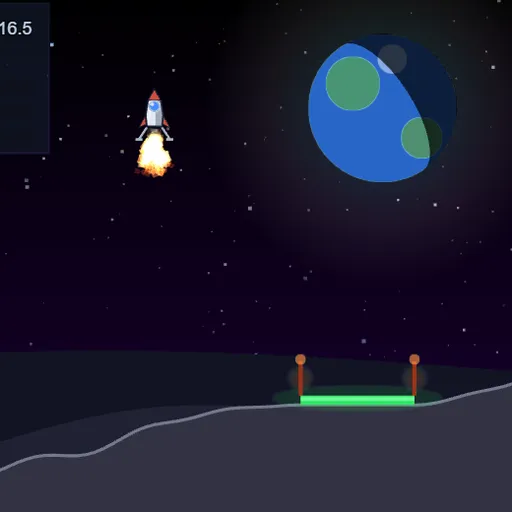
Moon Lander is a short physics challenge where you guide a falling spacecraft onto a lit landing pad. You only get a rotating hull and one engine, and the fuel is limited. It is worth playing because it makes you feel momentum and acceleration directly, which most screens never do.
Your first descent
After you press PLAY, the craft is already dropping toward gray hills. A green pad sits somewhere below between two beacons, and the camera keeps both in view. Thrust pushes the lander in whatever direction its nose points, so tilting lets you slide sideways and pointing straight up slows the fall.
The panel in the top left lists level, score and altitude, plus FUEL, SPD and TILT bars. The last two turn green when your speed and angle are safe. Touch the pad with both green to clear the level. Touching the hills, landing too hard, landing at an angle or leaving the map ends the game on the spot.
Moon Lander Controls
| Action | Keyboard | Mouse | Touch |
|---|---|---|---|
| Rotate the lander | Left and Right arrows, or A and D | — | Push the on-screen stick left or right |
| Fire the main engine | Up arrow, W or Space | — | Round thrust button |
| Restart from level 1 | R | — | — |
| Use the menus and the CONTINUE dialog | — | Click the buttons | Tap the buttons |
The physics you are learning
Gravity here adds a little downward speed every moment, just as it does on the real Moon. Thrust does the opposite, but only along the direction you face. That means your motion is the sum of two pushes, which is vector addition in action. A lander tilted 45 degrees splits its thrust between lifting and sliding.
The other lesson is momentum. Nothing stops by itself in space. If you drift right, you keep drifting until you push left with the same force. Players who plan their burns early use far less fuel than players who react late.
Pilot habits that work
- Settle your sideways drift while you are still high. Small corrections up there cost little.
- Pulse the engine. Brief taps let you read the SPD bar between bursts.
- Get upright before the final stretch, since turning near the surface is where many tips happen.
- Aim for the pad’s center, because later pads barely fit the legs.
- Treat fuel as score. Each spare unit is worth 4 points.
Before you play
Your best score is saved in the browser. Keyboard, gamepad and touch all work, and a run can last from 30 seconds to several minutes. If you like steering a drifting ship, Rock Blaster uses the same coasting physics, and Sky Hop is a gentler gravity game.
Tested and updated: