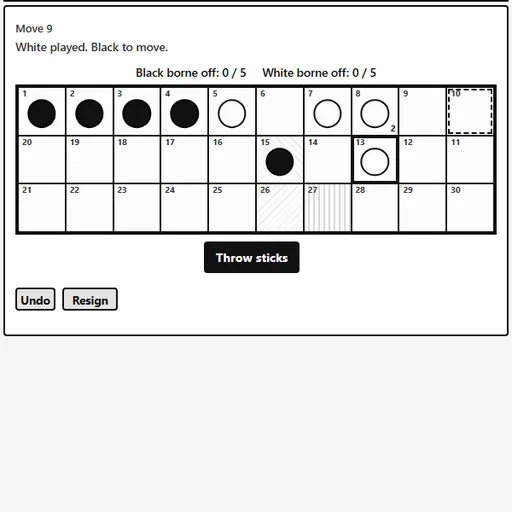
Senet is a race game from ancient Egypt, found painted in tombs and played for many centuries. Each player moves five pieces along a 30-square track that zigzags across three rows, and the first to bear all of them off wins. It is worth playing for its odd mix of luck and choice: throwing sticks sets your number, but deciding which piece to move, when to pair up and how to handle the last squares decides most games. This version follows a common modern reconstruction of the rules.
The track and a turn
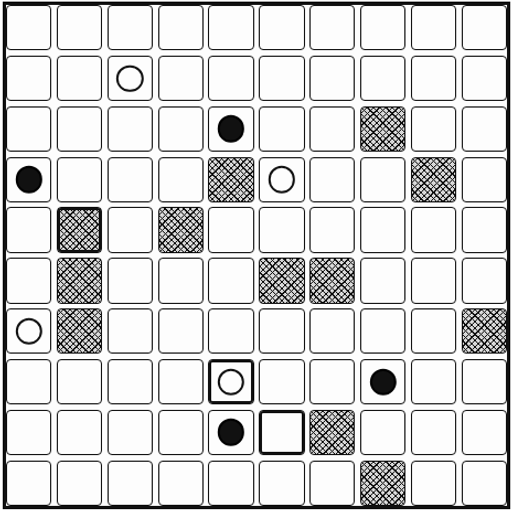
The ten pieces begin on squares 1 to 10, alternating colors. Press Throw sticks. Four sticks fall, and the count of marked sides is your move; no marked sides means 6. Pick a highlighted piece and move it forward.
Landing on a single enemy piece swaps the two pieces. A pair of enemy pieces cannot be landed on. Throws of 1, 4 and 6 earn another throw. Near the end, every piece must stop exactly on square 26 before going further, and square 27 sends a piece back to 15. A piece leaves with an exact throw just past square 30.
Senet Controls
| Action | Keyboard | Mouse | Touch |
|---|---|---|---|
| Throw the sticks | Tab to "Throw sticks" and press Enter | Click "Throw sticks" | Tap "Throw sticks" |
| Move a piece | Tab or arrow keys to a highlighted square, then Enter | Click a highlighted piece | Tap a highlighted piece |
| Choose color and opponent | — | Pick a color and a level, then click "New game" | Pick a color and a level, then tap "New game" |
| Undo or resign | — | Click "Undo" or "Resign" | Tap "Undo" or "Resign" |
Odds of the sticks
With four sticks there are 16 equal outcomes. Six of them show two marked sides, four show one, four show three, one shows four and one shows none, which counts as 6. So a 2 is the most likely throw, and a 4 or 6 is rare. Knowing this helps you guess whether a piece three squares behind an enemy is likely to strike.
Ways to gain an edge
- Travel in pairs. Two pieces on one square form a wall your opponent cannot touch.
- Line up square 26. Try to stand where a common throw like 2 or 3 lands you exactly on it.
- Spend extra throws well. After a 1, 4 or 6 you move again, so you can escape a threat and then build a pair.
- Swap late. Hitting an enemy piece near the finish costs your opponent the most ground.
- Keep a spare piece. A piece at the back gives you a safe use for awkward throws.
Before you start
No ancient rulebook survives, so these rules are one reasonable guess, not the only way to play. The game saves automatically and keeps counts of pieces borne off for both sides. Pair it with the Royal Game of Ur, another race from the ancient world, or the modern family race Ludo.
Tested and updated: