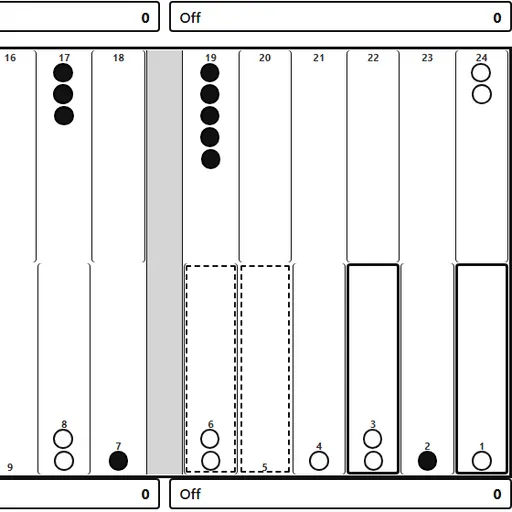
Backgammon is a two-player race in which each side moves 15 checkers around 24 points and tries to bear them all off first. The dice decide how far you go, but you decide how to use every roll, which is why strong players win far more often than chance alone would allow. This version from the PaperGames collection lets you play a computer at three levels or a friend on one device, with the doubling cube and gammon scoring included.
A turn, step by step
Press “Roll dice” and you get two numbers. Each number moves one checker that many points, and the same checker can use both. Doubles count four times. A point held by two or more enemy checkers is closed to you, while a point with just one enemy checker, called a blot, can be hit. A hit checker goes to the bar.
If you have a checker on the bar, it has to re-enter in your opponent’s home board before anything else moves. You must play both dice when you can. If only one die fits, the larger one must be used. When every one of your checkers is home, select a checker and press “Off” to bear it off.
Backgammon Controls
| Action | Keyboard | Mouse | Touch |
|---|---|---|---|
| Roll the dice | Tab to "Roll dice", then Enter | Click "Roll dice" | Tap "Roll dice" |
| Move a checker | Arrow keys to a point, Enter, then arrow to the target and Enter | Click a point with your checker (or the Bar), then the target point | Tap a point with your checker (or the Bar), then the target point |
| Bear off | — | Select the checker, then click "Off" | Select the checker, then tap "Off" |
| Offer a double before rolling | — | Click "Double" | Tap "Double" |
| Undo, resign or show the move list | — | Click "Undo", "Resign" or "Moves" | Tap "Undo", "Resign" or "Moves" |
| Set up a new game | — | Open "Menu", choose "2 Player (local)" or "vs Computer", then "New game" | Open "Menu", choose "2 Player (local)" or "vs Computer", then "New game" |
Where the math comes in
Backgammon is a probability game in disguise. Two dice make 36 possible rolls, and 11 of them contain at least one 6. Counting rolls like this tells you how risky a blot really is. The pip count under the dice is plain arithmetic too: it adds up the distance each side still has to travel, so you can see at a glance who leads the race.
Plans that work
- Make points, not blots. Moving two checkers to the same point turns a target into a block.
- Build a prime. Six held points in a row form a wall no checker can cross. Even four or five in a row are hard to escape.
- Switch plans when the race changes. If the pip count shows you far ahead, stop fighting and run home safely. If you are behind, keep checkers back to hit late.
- Double from strength. The computer turns down a double when it trails by 16 pips or more, which hands you the cube value at once.
Things Worth Knowing First
Undo, a move list and a resign button sit under the board, and the computer’s speed can be set to fast, normal or slow. If you enjoy dice and safe squares, try the ancient Royal Game of Ur or the family race Ludo.
Tested and updated: