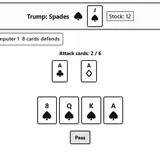
Durak is a Russian card game where the aim is to get rid of your cards, not collect them. Players take turns attacking and defending, and the last person left holding cards becomes the durak, the fool. It is worth learning because it mixes memory, simple probability and bluff-free planning, and a hand rarely goes the way you expect. This version comes from Christopher Müller’s open-source PaperGames collection.
How a round plays out
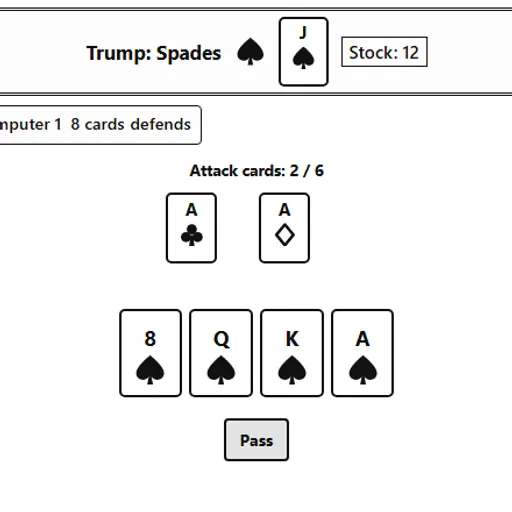
Each player gets six cards from a 36-card deck. The next card is turned face up under the stock, and its suit is trump until the game ends.
The attacker leads one card. The defender must cover it with a higher card of the same suit or with any trump. Other players, and the attacker, may then throw in more cards, but only ranks that are already on the table. A round can never hold more than six attack cards, and never more than the defender held at the start.
If the defender covers everything, the pile is discarded and the defender attacks next. If not, the defender picks up every card on the table and the attack skips them. Everyone draws back up to six. Once the stock is gone, players who run out of cards are safe. The last one holding cards loses, and a tie at the very end is a draw.
Durak Controls
| Action | Mouse | Touch |
|---|---|---|
| Attack, defend or throw in a card | Click the card in your hand | Tap the card in your hand |
| Pick up the cards on the table | Click "Take the cards" | Tap "Take the cards" |
| Stop throwing in | Click "Pass" | Tap "Pass" |
| Pass the attack to the next player (optional rule) | Click "Pass the attack on", then the matching card | Tap "Pass the attack on", then the matching card |
| Set up a game | Choose vs Computer or Same device, players, level and rules, then click "New game" | Choose vs Computer or Same device, players, level and rules, then tap "New game" |
What Durak trains
Durak is a counting game in disguise. With only 36 cards and one face-up trump, you can track which high cards and trumps are still out. That turns guesses into estimates, which is basic probability in action.
It also rewards timing. Playing a low card early, while the stock can refill your hand, is often worth more than holding it. Spending a trump on a weak attack can leave you helpless later. Weighing a small cost now against a bigger cost later is the same kind of thinking used in strategy games and budgeting.
Tips for staying out of the fool’s seat
- Lead your Sixes and Sevens while the stock still has cards.
- Save trumps for the end, when nobody can draw replacements.
- Attack with a rank you hold twice, so you can throw in the second copy.
- Sometimes picking up a small pile is cheaper than spending your best card.
- Remember the face-up trump. It will be the last card drawn from the stock.
- Count how many trumps have been played. If most are gone, your high off-suit cards become much safer.
Options and modes
Before a game you choose vs Computer or Same device, the number of players from two to four, the computer level and an optional pass-the-attack rule. In Same device mode, hands are covered between turns so friends cannot peek. Status messages explain why a card cannot be played, which helps while you learn.
If you want a calmer card game afterward, try FreeCell Solitaire, or switch to memory work in Memory Pairs.
Tested and updated: