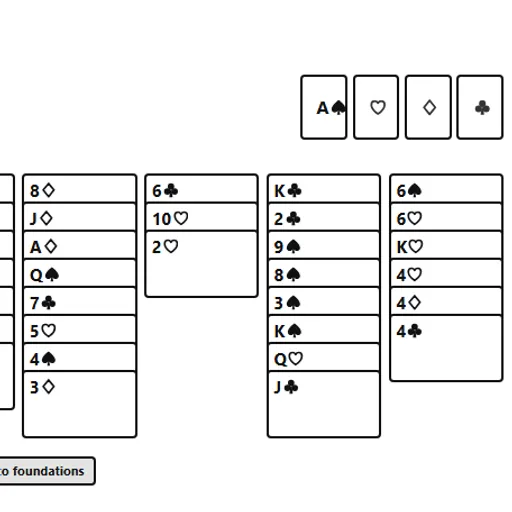
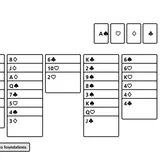
FreeCell Solitaire is a patience game where you can see every card from the very first move. All 52 are dealt face up into eight columns, and four free cells give you parking spaces while you untangle the mess. Because nothing is hidden, FreeCell Solitaire is almost pure planning, which makes it one of the best card games for logical thinking.
Rules in brief
The first four columns get seven cards and the last four get six. You may move the bottom card of a column onto a card one rank higher in the opposite color, like a black 8 on a red 9. Any card can go into an empty column.
Each free cell holds a single card. Moving a card there frees whatever was under it, and later you play it back to a column or straight to a foundation.
The four foundations start with Aces and build up by suit to Kings. When all four Kings are home, the game shows a Cleared message. A move counter tracks how efficient you were.
FreeCell Solitaire Controls
| Action | Keyboard | Mouse | Touch |
|---|---|---|---|
| Select a card, run or free-cell card | Tab to the card, then Enter or Space | Click the card | Tap the card |
| Move the selection | Tab to the target, then Enter | Click a column, an empty free cell or the matching foundation | Tap a column, an empty free cell or the matching foundation |
| Send every playable card home | — | Click "Collect to foundations" | Tap "Collect to foundations" |
| Undo | — | Click "Undo" | Tap "Undo" |
| Start a new deal | — | Click "New game" (under "Menu" if hidden) | Tap "New game" (under "Menu" if hidden) |
The logic behind FreeCell
FreeCell is a resource puzzle. Free cells and empty columns are your only room to maneuver, and the formula for moving runs shows exactly how much they are worth. One empty column doubles your capacity, while one free cell only adds one. That is why experienced players guard empty columns so carefully.
Since every card is visible, you can think several moves ahead and check your plan before you start. The game turns into a search problem: find a sequence of moves that frees the low cards without running out of space. Using Undo to try a line and step back is a good way to practice that kind of search.
A plan that works
- Before moving anything, find all four Aces and the 2s. Note which columns bury them.
- Pick the column that is easiest to dig out and start there.
- Use free cells for one clear purpose at a time, and empty them as soon as you can.
- Treat an empty column as more valuable than an empty cell.
- Build long alternating runs, since they can travel as one unit later.
- Press Collect to foundations once the board opens up to clear the easy cards.
Small Details That Help
There is no timer, so a game takes as long as you want to think. Cards are drawn in clear black and white with large text, and the select-then-place controls work well with a mouse, a finger or the keyboard. When you want a game with some hidden cards and luck, try Klondike Solitaire. For a longer two-deck puzzle, move on to Spider Solitaire.
Tested and updated: