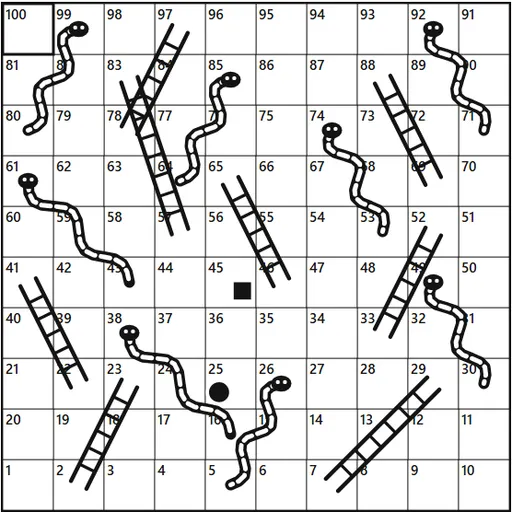
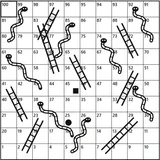
Snakes and Ladders is a dice race on a numbered board where ladders carry you up and snakes slide you back down. The first token to reach the last field wins. There is no strategy to it, and that is the point: a five-year-old can beat a grown-up fairly. It is a gentle way for young kids to practice counting and reading numbers to 100. This version from the PaperGames collection uses clear black-and-white drawings and offers a 100-field board and a 50-field board.
How to play a round
Every token starts off the board. Tap Roll and your token moves forward by the number on the die on its own. Fields zigzag up the board, left to right on one row and right to left on the next.
Stop at the bottom of a ladder and you climb to the top. Stop on a snake’s head and you slide to its tail. The status line names each ladder and snake, and a small table lists the latest moves with the roll and both fields.
Snakes and Ladders Controls
| Action | Mouse | Touch |
|---|---|---|
| Roll the die | Click "Roll" | Tap "Roll" |
| Let a computer player take its turn | Click "Continue" | Tap "Continue" |
| Set up the next game | Choose board, finish rule, players, computers and who starts, then click "New game" | Choose board, finish rule, players, computers and who starts, then tap "New game" |
| Show the setup again during a game | Click "Menu" | Tap "Menu" |
What children learn from it
The board is a number chart, so each turn is a small counting lesson. Ask a child to count the fields aloud, or to predict where a roll of 4 will land. On the 100 board, rows of ten help kids see how numbers grow by tens. You can also talk about chance: every face of the die is equally likely, so nobody can plan a ladder.
Tips for parents and teachers
- Start small. The 50-field board keeps a young player’s attention to the end.
- Use tap mode. Leaving computer turns on Continue gives children time to follow each move.
- Check with the move table. After a slide, read the start and end fields together and count the difference.
- Pick shapes, not colors. Tokens are a circle, square, triangle or star, which are easy to tell apart.
- Add suspense. The exact-finish rule keeps everyone in the game until the very last roll.
Setup options
Set the number of players, from two to four, and how many the computer runs. Choose the board, the finish rule and who goes first. A game in progress is saved in your browser. When kids want real choices, move on to Ludo, or try Dominoes for matching numbers.
Tested and updated: