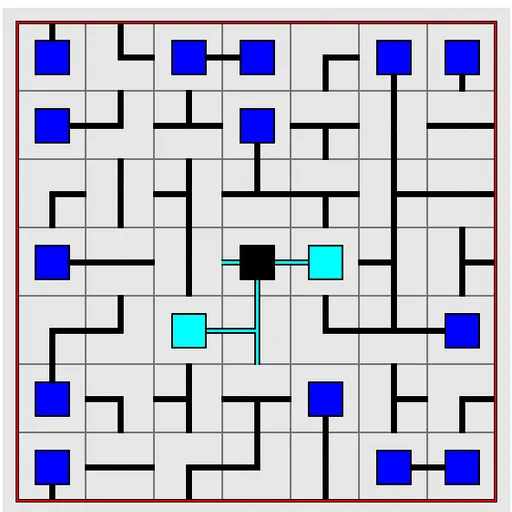
Net Pipe Puzzle starts with a working pipe network that has been scrambled by spinning every tile at random. You cannot move the tiles, only turn them, and your job is to rebuild a network where every square is joined and no pipe runs in a circle. Net Pipe Puzzle comes from Simon Tatham’s Portable Puzzle Collection, and each board has exactly one solution, so logic will always get you there.
The pieces and the goal
Every tile holds one of four shapes: a dead end, a straight, a corner bend or a T-junction. The black square near the middle is the source. Tiles connected to it light up, and the status bar counts how many tiles are active.
You win when all tiles belong to one connected network, no pipe points into the outer wall, and there are no closed loops. If you form a loop, it is drawn in red. Finishing turns the status bar to COMPLETED.
Boards range from 5x5 to 13x11, and each size also comes in a wrapping version where pipes pass through the edges.
Net Pipe Puzzle Controls
| Action | Keyboard | Mouse | Touch |
|---|---|---|---|
| Rotate a tile anticlockwise | Arrow keys to select, then A | Left-click | Tap |
| Rotate a tile clockwise | D | Right-click | Press and hold |
| Rotate a tile by 180 degrees | F | — | — |
| Lock or unlock a tile | S | Middle-click or Shift + click | — |
| Shift a wrapping grid / move the light source | Shift + arrows / Ctrl + arrows | — | — |
| New game, undo, redo | N, U, R | Menu buttons above the grid | Menu buttons above the grid |
The idea behind it
A finished network with no loops is what mathematicians call a tree: every square is reachable, and there is exactly one path between any two. That is the same structure used to design water mains and computer networks, where you want everything connected without wasting pipe on extra routes.
Solving it trains constraint reasoning. Each tile has at most four orientations, and its neighbors rule some of them out. Small certainties spread outward until the whole grid falls into place.
Where to start and how to keep going
- Work the border. An edge tile cannot point outward, which often leaves one or two options.
- Corners are almost free. On a non-wrapping board, a bend in a corner has only one legal turn, and a T-junction can never sit there.
- Keep dead ends apart. Two dead ends facing each other would make a sealed pair, so one must turn away.
- Put T-junctions flat to the wall. A T on the edge must have its flat side against the border.
- Lock the sure tiles. On large boards, locking stops accidental turns.
- Save wrapping for later. With no walls, you must reason from the pieces alone.
Before You Press Play
Undo and redo are unlimited, and the full game works from the keyboard with a cursor. A 5x5 board takes a couple of minutes, and the largest boards can take half an hour. For a twist on the same network idea, try Netslide Pipe Puzzle, or lay a single route in Train Track Logic.
Tested and updated: