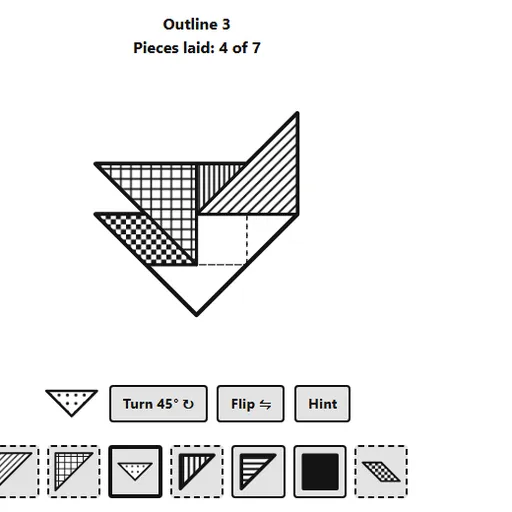
Tangram is the old shape puzzle made from seven pieces cut from one square. You fit all seven into a silhouette so there are no gaps and no overlaps. This version comes from Christopher Müller’s open-source PaperGames collection, with 90 outlines and tap-only controls. It is a great way to build spatial reasoning and a feel for how shapes combine.
How to Place Pieces
The pieces wait in a tray under the outline. Tap one to choose it, press Turn 45° to rotate or Flip to mirror, then tap inside the outline. The piece snaps to the nearest spot where it fits. Tap a laid piece to lift it again.
A counter shows how many of the seven pieces are down. When the outline is fully covered, Next outline loads the next unsolved shape. Easy outlines show faint guide lines. Medium and Hard show only the shape, and the Outline only set lets pieces sit wherever you tap, even partly outside, just like loose pieces on a table.
Tangram Controls
| Action | Mouse | Touch |
|---|---|---|
| Choose a piece | Click the piece in the tray below the outline | Tap the piece in the tray below the outline |
| Turn or flip the chosen piece | Click "Turn 45°" or "Flip" | Tap "Turn 45°" or "Flip" |
| Place the piece | Click inside the outline where it should go | Tap inside the outline where it should go |
| Pick a laid piece up again | Click the laid piece | Tap the laid piece |
| Get help | Click "Hint" to lay one piece correctly | Tap "Hint" to lay one piece correctly |
The Geometry Inside
All seven pieces come from one square, so their areas fit together neatly. If the small triangle has area 1, the square, the parallelogram and the medium triangle each have area 2, and each large triangle has area 4. The whole set has area 16. Every silhouette therefore has the same area, no matter how different the shapes look.
That also means pieces can swap in your head. Two small triangles cover the same area as the square, and they can form the square, the medium triangle or the parallelogram. Seeing those swaps is real geometric thinking about congruence and area.
Ways to Get Unstuck
- Place the big triangles first. They cover half the area, so their positions limit everything else.
- Read the sharp points. A 45 degree tip in the outline usually needs a triangle corner.
- Leave the parallelogram for last, and try both of its sides.
- Use one hint. A single correct piece often makes the rest of the shape clear.
- Think in pairs of small triangles when a gap looks awkward.
Things Worth Knowing First
Most Easy shapes take a few minutes. Pieces use black-and-white patterns instead of colors, so they stay clear on any screen. For more shape fitting, try Five-Square Tiling Puzzle, or the symmetry rules of Galaxies Symmetry Puzzle.
Tested and updated: